
The draft Local Plan puts 25,000 homes in five growth areas, against a target of 1,609 a year. The adopted plan dates from 2018, and committee approved 8 of 8.
The plan that governs what gets built in Hammersmith and Fulham was adopted on 28 February 2018. It is eight years old, and it predates the current London Plan, the 2024 revision of the National Planning Policy Framework and the government’s May 2025 standard method for calculating housing need. The council knows this: it published a draft replacement in October 2025 and consulted on it from 29 October to 10 December. That draft has not been examined and carries little weight in decisions yet, but it is the clearest statement available of where the council intends to put new housing.
Three housing numbers, and they do not agree
- 1,609 homes a year. The borough’s target in the London Plan (2021), running to 2029. This is the number the council is formally held to.
- 2,769 homes a year. The Local Housing Need figure produced by the government’s updated standard method of May 2025, from the council’s own commissioned Local Housing Needs Assessment. That is 72% above the London Plan target. The council’s draft plan notes it would only apply if the London Plan were not in force, and that it includes the Old Oak and Park Royal area, which is a separate planning authority with its own target.
- 88,000 homes a year for London. What the Greater London Authority is proposing in the next London Plan, to be divided between the boroughs. Hammersmith and Fulham’s share will be set from that, and the council’s draft plan says its figure will be “amended accordingly”.
The draft plan’s own answer is to aim above the London Plan target rather than at it. Policy HO1 commits the council to work to exceed 1,609 a year to 2029, and to keep seeking at least 1,609 a year through to 2042.
Where 25,000 homes are meant to go
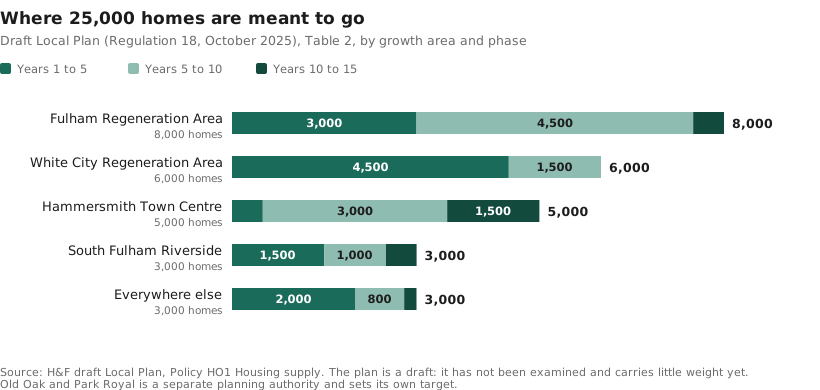
The draft plan sets out 25,000 homes across three five-year phases. Two thirds of them are in Fulham and White City, and the phasing tells you as much as the totals: White City is front-loaded, with 4,500 of its 6,000 homes in the first five years and nothing at all in the last five, while Hammersmith Town Centre barely starts until year six.
The Fulham Regeneration Area carries the largest number at 8,000, with its peak in years five to ten. South Fulham Riverside adds 3,000. If the plan runs as written, the character of the streets between Wandsworth Bridge Road and the river changes more than anywhere else in the borough over the next fifteen years.
On affordable housing, draft Policy HO3 keeps the strategic target at 50% of all dwellings, with a tenure split of 70% social rent to 30% intermediate, and applies a requirement to schemes as small as one to nine units. Whether 50% survives examination is the question worth watching, since the equivalent figure is contested at almost every London plan examination.
What the committee actually decided
The Planning and Development Control Committee met on 7 July 2026 and took eight applications. It approved all eight. Seven were unanimous; the only split was three to two, on advertisement consent for banners in Bishop’s Park, where two objectors spoke.
Two of the eight are worth knowing about.
Liberty House, 76 to 80 Hammersmith Road, W14 (reference 2024/02007/FUL) is the big one. MRP Hammersmith Limited will partially demolish and rebuild the site as a 10-storey life science and office building plus a hotel of about 371 bedrooms in a part five, part nine storey block, with a café, bar, conferencing and gym space and new public realm. The officer report secures 2,027 square metres of affordable workspace at a minimum 20% discount to market rates, plus employment, training, apprenticeship and local procurement commitments through the section 106 agreement, and requires at least 10% of hotel bedrooms to be fully wheelchair accessible.
It contains no homes at all. That is not a criticism of the scheme, which the officers judged against employment and visitor-economy policy rather than housing policy, but it is worth holding next to the 1,609-a-year target. The application was validated on 8 August 2024 and decided on 7 July 2026: just under two years in the system.
Land west of Macfarlane Road and east of Frithville Gardens, W12 (reference 2025/01378/FUL) is smaller and more surprising. Padel Xtra Ltd will demolish brick sheds and a warehouse and put up a single-storey marquee holding three padel courts, converting the existing two-storey office block into a clubhouse. It is in White City ward, on the same stretch of road whose northbound entrance has been closed to traffic since May.
In both cases the committee delegated the final grant to the Executive Director of Place, subject to a satisfactory legal agreement, which is the standard route here.
How to find and comment on an application
This is where Hammersmith and Fulham is harder than most boroughs, and it is worth being blunt about why. The council changed its planning case management system in February 2026. The old public access register is still online and still returns a search form, but it has published nothing since the week of 23 February 2026. If you find it through a search engine and it shows you no recent applications, the register is not empty: you are looking at the wrong system.
The current register is the council’s NEC planning search, reached through the planning applications section of the council’s site. Building control searches moved at the same time. Licensing follows in September 2026, so expect the old system to break for that too.
For applications going to committee, the agendas and officer reports on the council’s democracy site are more useful than the register: each report runs to hundreds of pages and sets out the officer’s reasoning, the objections received and the section 106 heads of terms. The committee meets roughly monthly at 7pm, with the next meetings on 15 September and 13 October 2026.
Boundaries to check before you assume
Three traps catch people writing or reading about planning here.
Olympia is in this borough, not in Kensington and Chelsea, despite postal addresses that say “Kensington, London W14”. The Earls Court redevelopment site straddles the boundary between Hammersmith and Fulham and Kensington and Chelsea, so confirm which council decided a given application before repeating it. And Old Oak and Park Royal is a separate planning authority with its own targets and its own decisions, even though it sits inside the borough’s northern edge, which is why the standard-method housing figure above does not map cleanly onto what this council controls.
New building lands on roads that are already busy, and Wood Lane in particular is being rebuilt while White City grows. What gets approved also feeds through to what the ward-by-ward prices look like in a few years.
Frequently asked questions
What is Hammersmith and Fulham’s housing target?
1,609 additional homes a year to 2029, set by the London Plan (2021). The government’s May 2025 standard method produces a Local Housing Need figure of 2,769 a year for the borough, but the London Plan target is the one the council is held to while that plan is in force.
When was the Hammersmith and Fulham Local Plan adopted?
28 February 2018. A draft replacement was published in October 2025 and consulted on from 29 October to 10 December 2025, but it has not been examined and carries little weight in decisions yet.
Where are the new homes in Hammersmith and Fulham being built?
The draft Local Plan allocates 25,000 homes across five growth areas: the Fulham Regeneration Area (8,000), White City (6,000), Hammersmith Town Centre (5,000), South Fulham Riverside (3,000) and everywhere else (3,000).
How do I search planning applications in Hammersmith and Fulham?
Through the council’s NEC planning search, linked from its planning applications pages. The council changed system in February 2026, and the old public access register still loads but has shown nothing new since the week of 23 February 2026.
How much affordable housing does the council require?
Draft Policy HO3 keeps a strategic target of 50% affordable on schemes of 10 or more homes, split 70% social rent to 30% intermediate. Schemes of one to nine homes must also contribute. This is a draft policy and has not been examined.
When does the planning committee next meet?
The Planning and Development Control Committee meets at 7pm on 15 September 2026 and 13 October 2026. Agendas, officer reports and minutes are published on the council’s democracy site.
Sources
- H&F Local Plan for the 28 February 2018 adoption and the Regulation 18 consultation dates.
- Draft Local Plan, Policy HO1 Housing supply for the 1,609 target, the 2,769 standard-method figure, the GLA’s proposed 88,000 and the Table 2 growth area split.
- Draft Local Plan, Policy HO3 Affordable housing for the 50% target and the tenure split.
- Planning and Development Control Committee, 7 July 2026 for the eight applications, the votes and the officer reports on Liberty House and Macfarlane Road.
- H&F change of IT for planning and building control for the February 2026 system change and the September 2026 licensing move.
Planning decisions and policy figures change. The draft Local Plan is a draft: check the council’s own pages before relying on any policy figure here.
Have your say