
The council has approved a four-year litter enforcement contract paid for out of fine income, and bidders are scored on the share of fines they hand back.
Hammersmith and Fulham Council has approved a four-year contract for a private company to patrol the borough’s streets and issue litter fines. The contract will not cost the council anything to run. The company will be paid out of the fines it issues.
The decision was taken by Councillor Lisa Homan, the Cabinet Member for Community Safety, and published on 24 August. It takes effect on 28 August. It is a key decision and was open to call-in, and the council’s register records no call-ins.
The single line that shapes everything else sits in the council’s own procurement strategy. Under the heading “Being ruthlessly financially efficient”, officers write that the model is financially advantageous because “service delivery costs will be covered by revenue generated through Fixed Penalty Notices (FPNs)”.
Bidders compete on the council’s cut of the fines
Sixty per cent of the tender score is price. Price here does not mean what the company charges. The report is explicit:
Price will be assessed based on the percentage share of Fixed Penalty Notice (FPN) income offered to the Council by each bidder. The bidder offering the highest percentage share to the Council will receive the maximum available score for the Price criterion (60%).
The remaining marks are quality at 30 per cent and added value at 10 per cent. So the firm that hands the council the biggest slice of the fines starts with the largest single advantage in the competition.
The equalities annex describes the arrangement in plainer words still. It calls it “an external environmental enforcement agency operating under a zero-sum contract”.
What the pilot found: most fines go to people passing through
The council brought in an outsourced enforcement contractor in November 2025 on a six-month pilot, then extended it. The report sets out what that period showed:
- Enforcement was concentrated in the borough’s busiest town centres and transport hubs, not residential streets.
- The equalities annex names Hammersmith Broadway and Shepherd’s Bush as the kind of high-traffic areas that means in practice.
- “The majority of enforcement action has been directed towards visitors and individuals travelling into LBHF.”
- Officers are required to wear body-worn video.
- No fixed penalty notices are issued to under-18s in the borough.
The council has not published how many notices the pilot issued, how much money they raised, or how many were challenged. The financial detail sits in Appendix 1, which the same decision withholds from publication under paragraph 3 of Schedule 12A of the Local Government Act 1972, on the grounds that it concerns the financial or business affairs of a particular person.
The council’s own warnings
The report does not present this as risk-free. Its risk section, signed off by the council’s Risk and Assurance Manager, records:
- A medium reputational risk that “having passed the burden of recouping costs to the successful Supplier that they become overzealous in dispensing fines thereby angering residents”.
- A medium legal risk that the supplier exceeds “stated boundaries of engagement with residents or wider public”, exposing both the firm and the council to legal action.
- A high legal risk of “an added burden upon the local legal (magistrates) system”, with a recommendation that the courts and the police be warned of the likely increase in volume.
The equalities impact assessment rates the effect on two protected characteristics as negative rather than neutral. On race, it warns that because patrols concentrate on transport hubs and town centres such as Shepherd’s Bush, “there remains a risk that particular ethnic groups may experience disproportionate levels of contact with enforcement activity”. On pregnancy and maternity, it asks that officers be trained to use discretion. It also notes that a fine lands harder on people already short of money.
No formal consultation was carried out. The assessment says it draws instead on operational experience from the pilot, complaints data and benchmarking with Hounslow and Bournemouth.
What you can actually be fined
The amounts changed on 1 November 2025, the same month the outsourced patrols began. The Cabinet Member for Community Safety approved the increases on 28 October 2025.
| Offence | Full amount | If paid early |
|---|---|---|
| Littering | £250 | £200 |
| Fly-tipping | £1,000 | £500 |
| Graffiti and flyposting | £500 | £250 |
| Household waste duty of care | £600 | £300 |
| Commercial waste receptacle breach | £150 | No early rate |
The littering fine rose from £150 to £250 in that decision, against a legal maximum of £500. One change matters more than the headline number. The council decided to treat ordinary household waste, black bags and small items left on the pavement outside collection times, as littering at £250 rather than fly-tipping at £1,000. The £1,000 charge is now reserved for bulky items: mattresses, furniture, white goods and building materials.
Who holds the contract now
The papers do not name the current supplier. The report names three firms as companies that do this work in London and for neighbouring boroughs: Kingdom Services Group, 3GS and District Enforcement.
The council’s own fixed penalty payment page splits notices into two streams. Seven-digit numbers beginning with a zero go to the council’s own payment system. Nine-digit numbers go to a separate portal the council labels “Kingdom”.
Transfer of Undertakings protection does not apply to this contract, so staff on the current contract do not automatically move to whichever firm wins.
When it happens
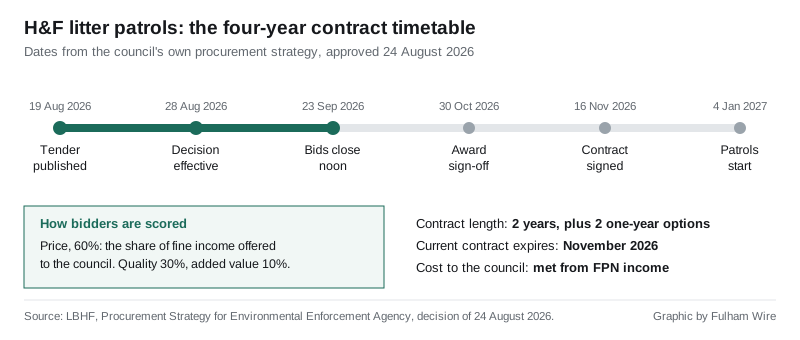
- Tender notice published: 19 August 2026
- Deadline for bidders’ questions: 5pm, 16 September 2026
- Bids close: noon, 23 September 2026
- Award sign-off by the Cabinet Member: 30 October 2026
- Standstill period ends and contract signed: 16 November 2026
- Contract start date: 4 January 2027
The report contradicts itself on one point. Its financial section says the four-year term runs “effective from 30th November 2026”, while its own timetable on a later page gives a contract start date of 4 January 2027. The current contract expires in November 2026, and officers list a gap between the two contracts as their first identified risk.
The contract runs for two years with two optional one-year extensions, a maximum of four. Performance will be reviewed quarterly, and the council says it will ask the supplier for a summary of complaints at each review.
What it means for you
If you live here, the council’s own analysis says you are less likely than a visitor to be stopped, because patrols are sent to town centres and transport hubs rather than residential roads. That is a statement about where officers were deployed during the pilot, not a promise about the next four years.
Three practical points:
- Putting your black bags out at the wrong time is now a £250 littering fine, not a warning. Check your collection day and put waste out only in the window your street is given.
- If you think a notice is wrong, challenge it in writing before the payment deadline. The council’s Law Enforcement Team can be reached on 020 8753 1100 or at let.hf@lbhf.gov.uk. The early payment rate is the cheaper option only if you accept the notice.
- Businesses face a separate £150 penalty for commercial waste receptacle breaches, with no early payment discount. If you run one of the shops, cafes or salons in our Fulham business directory, your trade waste agreement and where your bins sit are both now enforcement matters.
Anyone who wants to see the money before it is spent will have to wait. The financial appendix stays sealed until at least the award report in October.
Have your say