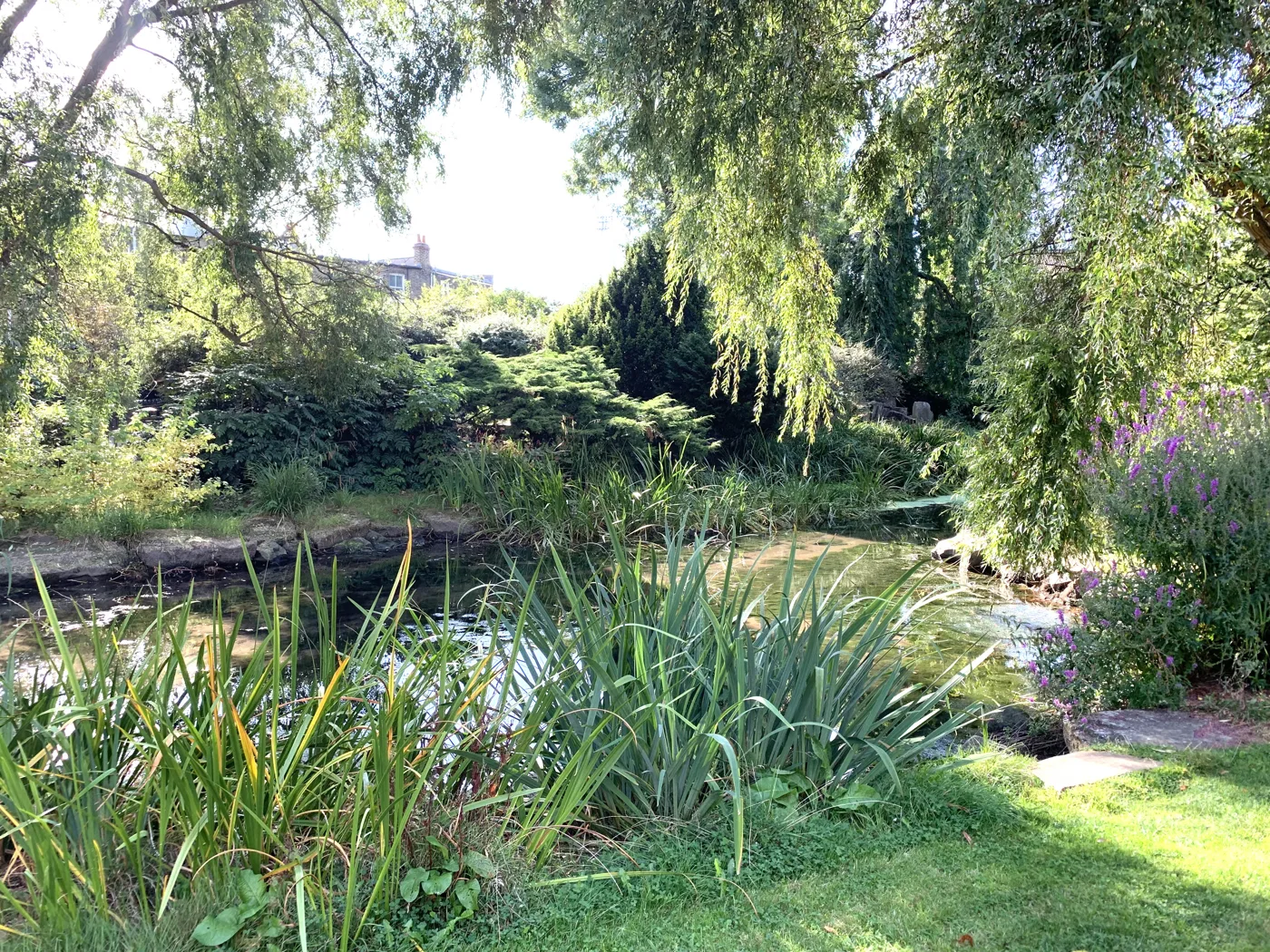

The dog control order runs to 2029: £100 fines, four dogs a person, on-the-spot penalties for fouling. Hammersmith Park's Japanese Garden bans dogs anyway.
Hammersmith and Fulham’s dog control rules come back into force on Monday 7 September and now run to 7 September 2029. Councillor Lisa Homan, the Cabinet Member for Community Safety, signed off the renewal on 1 September. All six restrictions in the 2023 order are kept.
Two parks are getting stricter rules despite most consultation respondents opposing them. Dogs are being banned from the Japanese Garden at Hammersmith Park, where 56.4 per cent were against the change. Loris Gardens is getting a partial ban, where 56.3 per cent were against.
What the rules actually say
The order is a Public Spaces Protection Order, made under the Anti-social Behaviour, Crime and Policing Act 2014. Six restrictions apply:
- Dogs banned outright in the areas listed in Schedule 1. That covers all children’s play areas, all fenced sporting areas and all fenced war memorial areas across the borough, plus a list of named spots.
- Dogs on leads in the areas listed in Schedule 2. This includes all cemeteries and churchyards the council controls, all wildlife conservation areas, all Tiny Forest sites, all outdoor gyms and all park cafes and tea houses.
- Leads on request, anywhere in the borough. An authorised officer can order a dog onto a lead, but only where restraint is reasonably necessary to prevent a nuisance, or behaviour likely to cause annoyance or disturbance, or the worrying of another animal or bird.
- Four dogs maximum, anywhere in the borough. One person may not walk more than four. Walkers may not group up so the combined total goes over four either.
- Pick it up, anywhere in the borough. Failing to remove your dog’s faeces is an offence.
- Carry a bag or scoop, anywhere in the borough. You must be able to produce one when an authorised officer asks.
Nothing in the exclusion, fouling or bag rules applies to someone who relies on an assistance dog because of a disability.
The fine, and a discrepancy worth knowing
The fixed penalty is £100, and you get 14 days to pay before prosecution. The reduced early-payment rate is £60. On that point the council’s own paperwork does not agree with itself. The draft order says £60 if paid within seven days. The decision report says ten days, in two separate places. The order is the legal instrument, so assume seven days and pay early if you get one.
Fixed penalties can be issued by council Law Enforcement Officers, police officers, PCSOs and other authorised people. Refuse to pay and you can be prosecuted, with a fine of up to level 3 on the standard scale, currently £1,000.
Enforcement is not uniform across the six rules. For fouling and for walking too many dogs, the report says a fine is issued on the spot, “because the intention of the ASB is deliberate and evident”. For the other four, officers use the Metropolitan Police’s four Es approach, Engage, Explain, Encourage and Enforce, and only fine someone who carries on after being asked to stop.
Three years, 178 fines
The report sets out how often the order has actually been used since it started in June 2023.
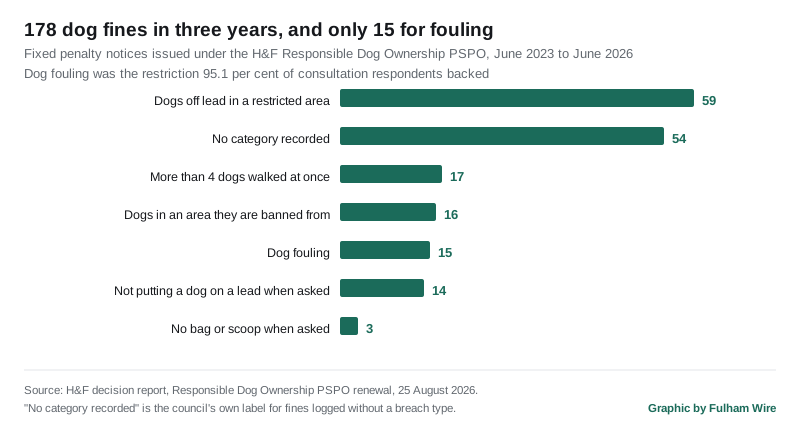
That is 178 penalties in three years across a borough of four postcode districts, or roughly one a week. The largest single category is dogs off a lead in a restricted area, at 59. Another 54 were logged with no category recorded at all.
Dog fouling produced 15 fines. It is the restriction residents backed most strongly, at 95.1 per cent, and the report says fouling is the problem residents raise most. It is also the one where the council says it fines on the spot.
The consultation, and where the council went the other way
The consultation ran for 31 days, from 8 May to 8 June 2026, on the council’s Have Your Say platform, with an easy read version published alongside. It drew 1,437 responses. Of those, 66.1 per cent backed renewing the order, 12.9 per cent were against, 13.2 per cent said maybe and 7.9 per cent were unsure.
Support varied a lot by restriction:
| Restriction | In favour |
|---|---|
| Clearing up dog fouling | 95.1% |
| Leads on request | 81.1% |
| Four dogs maximum per person | 68.9% |
| Dog exclusion areas | 67.6% |
| Dogs on leads areas | 66.9% |
| Carrying a bag or scoop | 66.6% |
| Adding Tiny Forests to the leads areas | 48.8% |
| Four dogs maximum per group | 42.4% |
The council also asked about eight specific parks. Four changes had majority support and are going ahead: Cathnor Park (68.3 per cent in favour), Wendell Park (60.5 per cent), Bayonne Road (56.6 per cent) and Brook Green (53.2 per cent).
Two proposals were dropped after residents said no:
- Wormwood Scrubs keeps its 2023 restrictions rather than expanding the dogs-on-lead area. The vote was 50.1 per cent in favour, which officers judged too close. Instead they will patrol and explain the habitats there, and review whether enforcement is needed later.
- Westcroft Square stays a dogs-on-lead area rather than becoming a no-dogs area. Sixty eight per cent opposed the change and the report says there was not sufficient data to justify going against that.
Two proposals went ahead anyway:
- Hammersmith Park’s Japanese Garden becomes a no-dogs area, with 56.4 per cent against. The council’s reasons: six fixed penalties have been issued in Hammersmith Park under the current order, the Friends of Hammersmith Park and the Friends of the Japanese Garden of Peace both asked for it, it is the UK’s oldest Japanese garden, and it was a no-dog zone before the earlier dog control orders.
- Loris Gardens gets dog exclusion on the grassed amenity areas, with 56.3 per cent against. Dogs can still use the central path, on a lead. The Hammersmith Community Gardens Association reported persistent fouling, uncontrolled dogs, and schools, families and volunteers using the gardens less as a result.
A PSPO consultation is not a vote, and a council is entitled to weigh evidence against numbers. But in both cases the council has gone against the majority view it asked for, and the reasoning is worth reading if one of those parks is your local.
Where dogs are banned entirely
Beyond every children’s play area, fenced sporting area and fenced war memorial in the borough, Schedule 1 names:
- all the grounds of Fulham Palace
- Bishops Park: the fenced picnic area and the pond area
- Eel Brook Common: the fenced picnic area and the fenced flower garden
- Furnivall Gardens: the walled garden
- Godolphin Road Open Space: the pond area
- Gwendwr Gardens
- Ravenscourt Park: the picnic area, walled garden, the fenced area round the lake and the wildlife area
- Rowberry Mead Open Space
- St Paul’s Garden: the fenced picnic area
- South Park: the pond area
- Vicarage Gardens
- Wendell Park: the school zone and the fenced picnic area
- Hammersmith Park: the Japanese garden
- Loris Gardens: the wildlife zone and the east side of the central path
- Bayonne Road: the east side of the park
- Brook Green: the community garden
- Cathnor Park: the north east of the park
The lead-only list in Schedule 2 includes two cemeteries outside the borough that the council still runs, Mortlake Cemetery and North Sheen Cemetery, both in Richmond. It also covers the five Tiny Forest sites at Hammersmith Park, Normand Park, Eel Brook Common, Frank Banfield Park and Wormholt Park.
What it means for you
If you walk a dog in the borough, four things change or matter from Monday.
- Check the two parks. If you use the Japanese Garden at Hammersmith Park, you can no longer take a dog in at all. If you use Loris Gardens, the grass is out and the central path is lead-only.
- Carry a bag every time. Not carrying one is its own offence, separate from fouling, and an officer can ask you to produce one anywhere in the borough. Only three people have been fined for this in three years, but the rule is unchanged.
- Professional walkers, count your dogs. Four is the limit per person, and you cannot get round it by walking alongside someone else. Seventeen fines have been issued for this.
- Pay within seven days if you are fined. That halves the £100 to £60, on the order’s own wording.
The council expects the rollout to cost £4,500, all of it signage, from the Community Safety general fund budget. Signs are how a PSPO becomes enforceable in practice, and the report notes that residents who commented were largely supportive but unhappy about “a perceived lack of enforcement and signage”.
Anyone who lives in, regularly works in or visits a restricted area can challenge the order in the High Court, but only within six weeks of it being made, and only on the grounds that the council lacked the power to make it or failed to follow the legislation.
For other council decisions affecting your street, see our Fulham planning news page, and parking in Fulham for the borough’s other camera and officer enforcement.
Sources
- H&F decision record, renewal of the Responsible Dog Ownership PSPO, decided and published 1 September 2026, effective from 5 September 2026.
- Decision report by Chloe Jackson, Community Safety Project Officer, 25 August 2026 for the 1,437 responses, the percentages, the 178 fixed penalties, the £4,500 cost, the four Es approach and the park-by-park reasoning.
- Appendix 1, the draft order for the six restrictions, the schedules of restricted areas, the £100 and £60 fixed penalty, the level 3 maximum fine, the assistance dog exemptions and the High Court appeal route.
Have your say