
Visits to Fulham rose 22% in the first nine months of 2026, the fastest growth of the borough's three town centres. Summer international visitors rose 87%.
Overview
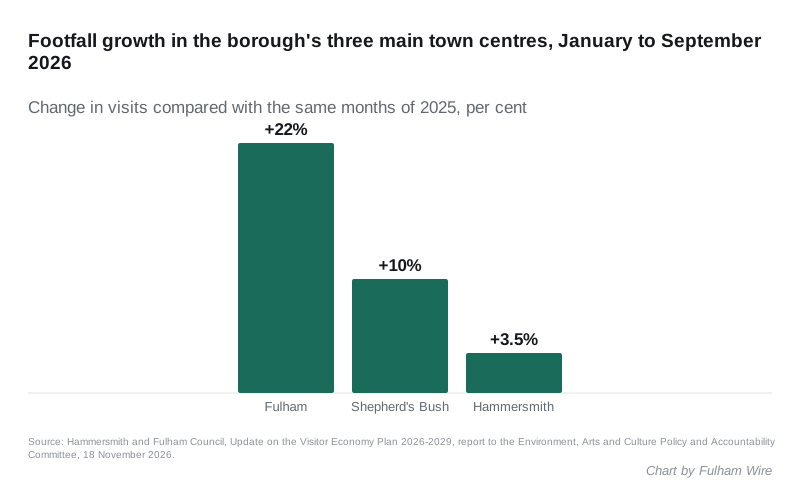
Visits to Fulham rose by 22% between January and September 2026, compared with the same months last year. That is the fastest growth of the borough’s three main town centres. Shepherd’s Bush still draws the most visits, about 15.6 million so far this year. The figures are in a council report going to councillors on Wednesday 18 November.
Fulham had the strongest growth in footfall of any town centre in Hammersmith and Fulham this year. Visits rose 22% on 2025, and the summer was stronger still.
Between July and September, Fulham’s footfall was up 28% on summer 2025. Visitor spending rose 14%. The number of international visitors rose 87%.
The figures come from an update on the borough’s Visitor Economy Plan. Council officers wrote it for the Environment, Arts and Culture Policy and Accountability Committee, which meets at 145 King Street at 7pm on 18 November.
The three town centres in 2026
The report compares January to September 2026 with the same period of 2025:
| Town centre | Footfall | Spending |
|---|---|---|
| Fulham | up 22% | not given for the nine months |
| Shepherd’s Bush | up 10%, almost 15.6 million visits | up 14% |
| Hammersmith | up 3.5% | up 10.9% |
Across the whole borough, the report says summer 2026 was the strongest on record in the High Street Data Set. There were 22.3 million visits across the borough. That is 8.9% more than summer 2025 and 10.6% more than summer 2024.
Visitor spending this summer was 24% higher than in summer 2025, the report says. Annual footfall in the borough rose by almost 68% between 2022 and 2025.
What visitors are worth to the borough
The plan behind the figures is the borough’s first Visitor Economy Plan, covering 2026 to 2029. It was finished in June. The full plan is published as an appendix to the report.
Its headline numbers:
- domestic visitors spend an estimated £324 million a year in the borough
- tourism supports almost 1,500 businesses and about 18,000 jobs, 12% of all jobs here
- there are about 7.56 million day visits a year, worth £274 million
- a day visitor spends £36 on average; an overnight visitor spends £211
Overnight stays are only 3.3% of visits but 16.6% of spending. That is why the plan wants more people to stay the night.
The report also names a weakness. Too many visits are “touch and go”, it says, “particularly around events such as football, with visitors arriving for an event and leaving straight after”. The borough ranks 19th of London’s 33 boroughs for day visits, 15th for overnight trips and 12th for business tourism.
What the council wants to do next
The plan aims to grow visitor spending by 10% above inflation by 2031. The report puts that at about £40 million to £50 million a year.
It picks six “neighbourhood hubs”: Hammersmith, Fulham, Shepherd’s Bush, Olympia, the White City Innovation District and Earls Court. Two or three will be audited first for signs, access, safety and the evening offer.
The priorities for the next 12 months include:
- independent research into how visitors see the borough
- a short “narrative” for each neighbourhood, written with local businesses
- a trial with one or two big events to keep visitors in the area before and after
- a group to take forward night-time economy measures
The partnership running the plan, Visit H&F, has no budget of its own. The report says it runs on council officers’ time and help from its partners, which include the business improvement districts, hotels and venues.
What it means for you
More visitors usually means more trade for Fulham’s shops, cafes and pubs, and the report shows the town is gaining on Shepherd’s Bush and Hammersmith. The plan’s focus on match days matters here: it wants football crowds to arrive earlier and stay longer, which could mean busier pubs and restaurants around Craven Cottage and Fulham Broadway on home games.
The committee meeting on 18 November is open to the public and is also shown on the council’s YouTube channel. Committee members will comment on the plan; it is not a decision meeting.
Have your say