
Cabinet has approved a rise of about a third in on-street parking, to £3.80 to £9.60 an hour, planned for January 2027. Resident permits rise with inflation only.
Pay-to-park charges on Hammersmith and Fulham’s streets will rise by about a third, after the council’s Cabinet approved the plan on Monday 16 November. The cheapest hourly rate goes from £2.80 to £3.80, and the dearest from £7.00 to £9.60. The council aims to bring them in during January 2027.
Overview
Updated 18 November: Cabinet approved the demand-management uplift and yearly inflation rises for all council-set parking charges, according to the Cabinet decision list. The decision could be called in until 3pm on Friday 20 November. The start date, the inflation measure and the rounding are delegated to the Executive Director of Place, and the new charges need a public notice before they take effect. No notice had been published when we checked on 18 November.
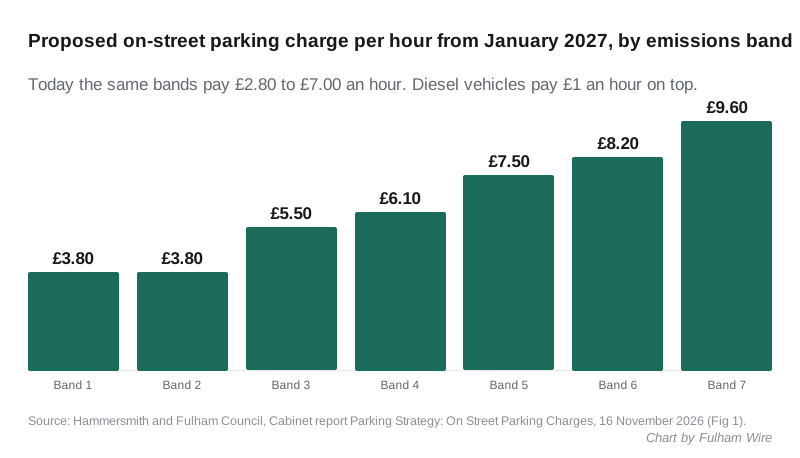
- Band 1 and 2 cars: £3.80 an hour, from £2.80.
- Band 7 cars: £9.60 an hour, from £7.00. Diesels pay £1 more.
- Resident permits and visitor sessions: inflation rise only.
- When: planned for January 2027, once the public notice is published.
The council says the aim is fewer car journeys, not more income. Residents parking in their own zone with a permit will still park free.
The figures are in the Cabinet report on on-street parking charges, published with the agenda for the 16 November meeting.
What each band will pay
Hammersmith and Fulham already charges by the car’s CO2 emissions, in seven bands, with a £1 an hour surcharge for diesel. Those bands stay. The report sets out an extra “demand-management uplift” on top of the usual yearly inflation rise.
| Band | Now (2026) | 2027 with inflation only | Proposed for 2027 | Rise on today |
|---|---|---|---|---|
| 1 | £2.80 | £2.90 | £3.80 | £1.00 |
| 2 | £2.80 | £2.90 | £3.80 | £1.00 |
| 3 | £4.00 | £4.20 | £5.50 | £1.50 |
| 4 | £4.50 | £4.70 | £6.10 | £1.60 |
| 5 | £5.50 | £5.80 | £7.50 | £2.00 |
| 6 | £6.00 | £6.30 | £8.20 | £2.20 |
| 7 | £7.00 | £7.40 | £9.60 | £2.60 |
All prices are per hour. The first three columns are the council’s own figures (Fig 1 in the report). The last column is our sum: the proposed charge minus today’s. On every band that works out at between 36 and 38 per cent more than now.
A diesel car still pays £1 an hour on top. A band 7 diesel will therefore pay £10.60 an hour.
Who escapes the extra rise
The report says these are excluded from the above-inflation uplift:
- resident parking permits
- visitor permits booked by residents
- the short-stay shopper bays near high streets
They still get the normal yearly inflation increase. So does every other parking charge the council sets. The report leaves the exact inflation measure and rounding to be confirmed later.
Blue Badge holders keep free parking in shared-use, resident, visitor and disabled bays. Residents with permits can still park free at all times in their home zone.
The council also plans more shopper bays. There are almost 40 now, and it wants over 100 in 2027. They allow up to two hours, from as little as 20p an hour.
Why the council wants it
The report says on-street parking is growing, not shrinking. Its figures:
- 2.47 million parking sessions in 2025/26, up 4.6% from 2.36 million the year before
- about 1.50 million sessions between April and October 2026
- electric and hybrid sessions up 27.9% between 2024/25 and 2025/26
- 84.3% of sessions in 2025/26 lasted two hours or less
The emissions-based charges came in during February 2025. The report’s point is that drivers switched to cleaner cars but did not drive less. “Cleaner vehicle choices are not the same as fewer car journeys,” it says.
The proposal comes from Councillor Nicole Trehy, Cabinet Member for Climate Emergency and Travel. The report links it to the council’s Net Zero 2030 target and its Air Quality Action Plan.
The council does not put a figure on extra income. The report says the effect on drivers is hard to predict. Any surplus has to go back into transport spending allowed under the Road Traffic Regulation Act.
Who the report says could lose out
The council’s own equality check names the people most likely to feel it:
- lower-income households, who are more likely to drive older, higher-emission cars
- disabled people who rely on a car
- people supporting disabled residents, and unpaid carers
The report says Blue Badge parking, visitor permits, shopper bays, car clubs and Dial-a-Ride partly offset this. It concludes the health and air quality benefits outweigh the costs.
Why it is being decided now
The rise is bigger than the October 2024 Cabinet decision lets officers make on their own. So it has to go back to Cabinet. The report says the decision is needed in November to bring the new charges in by January 2027. It was added to the key decisions list on 4 November.
What it means for you
- If you pay to park on-street, expect to pay about £1 to £2.60 more an hour from January, depending on your car’s band. Check your band through the DVLA vehicle information service.
- If you are a resident with a permit, parking in your own zone stays free. Your permit price and visitor sessions rise with inflation only.
- If you visit for a quick shop, the shopper bays are outside the extra rise.
- Watch for the public notice. Cabinet has decided, but the new charges need a formal notice under the Road Traffic Regulation Act before they take effect. The papers are on the council’s meetings site.
Today’s zones, hours and charges are in our guide to parking in Fulham. We will report the start date when the council publishes it.
Have your say